
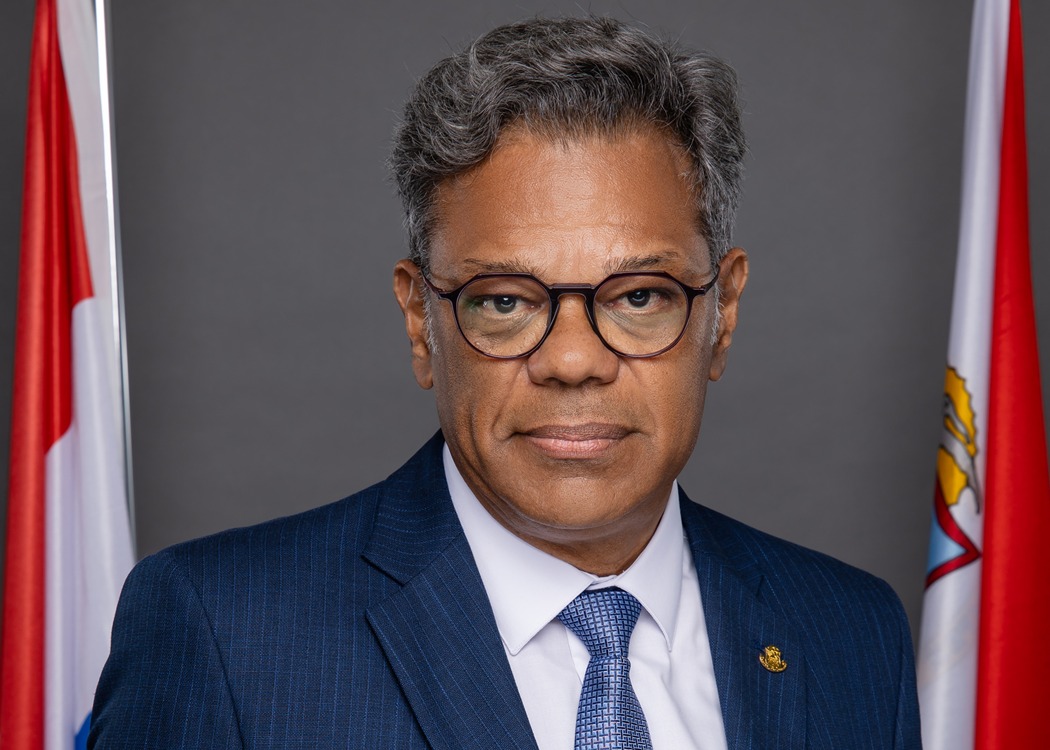
Prime Minister Dr. Luc Mercelina Presents One-Year Overview of Government Achievements
December 16, 2025 10:30 am
Philipsburg — Prime Minister Dr. Luc Mercelina has presented a comprehensive overview of the progress and achievements realized during his first year in office, highlighting steady advances in governance, national resilience, digital transformation, infrastructure development, and public-sector reform.
Since assuming office, the Prime Minister has led a coordinated, whole-of-government approach aimed at strengthening institutions, modernizing essential systems, improving service delivery, and enhancing Sint Maarten’s engagement at the regional, Kingdom, and international levels.“Our first year in office was about restoring stability, modernizing government, and strengthening the resilience of our country,” said Prime Minister Mercelina. “The progress achieved reflects disciplined planning, strong collaboration, and a shared commitment to ensuring that government works more effectively and responsibly for the people of Sint Maarten.”
Over the past year, Sint Maarten’s representation within the Kingdom of the Netherlands and on the international stage was strengthened. The appointment of Mr. Randolph Duggins as Sint Maarten’s State Councilor to the Kingdom’s Council of State enhanced the country’s participation in the Kingdom’s highest advisory body on legislation and governance.
Prime Minister Mercelina represented Sint Maarten at the United Nations General Assembly, where he engaged with regional and international partners, including leaders from Jamaica and St. Vincent and the Grenadines, on shared priorities such as climate resilience, sustainable economic development, and the debt challenges facing small island states. He also addressed a UNESCO-hosted event honoring the victims of slavery, emphasizing the importance of acknowledging history in shaping a more inclusive and equitable future.
“Sint Maarten’s voice must be present where decisions are made,” the Prime Minister stated. “We will continue to advocate for fair recognition of the unique vulnerabilities and realities facing small island countries.”
The Government strengthened regional cooperation through sustained dialogue with neighboring Caribbean governments, active participation in the Trust Fund Steering Committee, and the finalization of the Treaty on Hot Pursuit to enhance cross-border law-enforcement coordination. In response to advice from the Council of State, key evaluation committees were installed as part of the process marking 70 years of the Kingdom Charter. Continued alignment with European Union development frameworks enabled the unlocking and reprogramming of funding for critical sewerage and emergency shelter projects.
Energy security and national resilience remained central priorities during the year. Under the Prime Minister’s leadership, decisive measures were taken to stabilize electricity supply, including the leasing of 10 megawatts of containerized generators, the lease-to-own acquisition of an additional 20 megawatts, and the securing of a USD 42 million loan for the procurement of 30 megawatts of new generation capacity. A USD 1 million grant was secured to provide technical assistance to NV GEBE, and steps were initiated to establish a structured and transparent framework for fuel tariff regulation.
“Reliable energy is not a luxury—it is a foundation for economic stability, public safety, and quality of life,” said Prime Minister Mercelina. “We took necessary decisions to ensure continuity while laying the groundwork for a more reliable energy future.”
Significant progress was made in disaster risk management and emergency preparedness. Approximately USD 6 million was secured for the construction of a new Emergency Operations Center, alongside additional funding for tsunami preparedness, micro-insurance, Host Nation Support, and the strengthening of the Office of Disaster Management. RESEMBID-funded disaster risk management projects were completed, Starlink connectivity was installed at critical facilities, national cell broadcast infrastructure was implemented, and coordination with the French side was strengthened through harmonized disaster-management protocols. The Fire Department received its first operational drone, and outstanding risk insurance coverage for fire personnel was restored.
Major infrastructure initiatives advanced during the year, including continued progress on the construction of the hospital, the launch of a USD 25 million wastewater management project to expand and upgrade the sewer network and treatment plant, and the final phase of underground utility works by NV GEBE supported through Trust Fund financing.
Digital transformation remained a cornerstone of governance reform. Government-wide workshops were conducted to align digital initiatives and improve workflows. The Civil Registry system was migrated to more modern and resilient infrastructure, reducing downtime, while online bank-to-bank payment processing was introduced for vehicle tax transactions. A centralized digital tracking system for incoming documents was implemented, improving efficiency, transparency, and accountability across government operations.
At the institutional level, a National Enterprise Architecture Framework was established, progress was made on digital identity architecture including a new national ID number, and outdated ICT systems were replaced with modern cybersecurity infrastructure. Fiber connectivity now links key government facilities, failover systems were introduced to ensure continuity of services, and legislative drafting commenced for cybersecurity, data protection, and privacy frameworks. Three- and five-year ICT roadmaps were developed to guide Sint Maarten’s national digital transformation.
Public-sector reform delivered concrete improvements. A revised performance management cycle was implemented, and amendments to the Remuneration Policy introduced salary indexation, increased vacation allowance, expanded jubilees, and greater flexibility for internal career advancement. Function Books were completed for key departments, including ICT and the Fire Department, with progress continuing across ministries. The Employee Engagement Center was established, and the Government Training Center delivered onboarding, leadership, and professional development programs to hundreds of civil servants. The Prime Minister also engaged Sint Maarten students in the Netherlands to encourage future participation in national development.
Social development and citizen services were strengthened through increased funeral expense allowances for civil servants, the introduction of medical insurance coverage for VKS members, expanded Civil Registry outreach to residents with health or mobility challenges, and improvements to public information and customer support services. The Senior Citizen Fare program with WINAIR was also introduced to enhance affordability and regional connectivity for residents aged 65 and older.
Further progress was made in records management, asset optimization, and operational efficiency. The national digital scanning project resumed, resulting in the digitization of more than 135,000 pages of official records. Cost-efficiency measures included bulk procurement, rental contract reviews, utility rationalization, and improved fleet insurance arrangements. Infrastructure and operational milestones included the opening of the Fixed Base Operator building at Princess Juliana International Airport, upgrades to Police and Fire Department vehicles and equipment, improvements to the Government Administration Building, targeted road rehabilitation works, demolition of outdated public buildings to facilitate reconstruction, and the securing of funding for a new Mental Health Facility aligned with a long-term national vision.
In the area of development cooperation, the Government successfully closed the RESEMBID program, implemented European Union-funded initiatives in climate adaptation, agriculture, and education, and developed a national Development Cooperation Strategy aligned with regional and international frameworks. Public communication and media capabilities were also modernized through upgrades to broadcasting infrastructure, backup power systems, press briefing facilities, and the launch of a project to digitize historical audiovisual archives.
As the Government moves forward, Prime Minister Dr. Luc Mercelina reaffirmed his commitment to continued institutional strengthening, sustainable development, and responsible governance.
“This one-year overview reflects steady, deliberate progress,” the Prime Minister concluded. “We remain focused on building a resilient, inclusive, and well-governed Sint Maarten—one that is prepared for the challenges and opportunities ahead.”